Best Thermal Baths in Europe (2026): Top Destinations + Map
Looking for the best thermal baths in Europe for 2026? You're spoilt for choice. From the neo-baroque grandeur of Budapest and Iceland's milky-blue Blue Lagoon to Tuscany's free thermal waterfalls and Romania's wonderfully affordable spa towns, the continent is laced with naturally hot, mineral-rich water you can soak in year-round. This guide ranks the very best, with prices in EUR, how to get there, and where to stay.
We've covered seven headline destinations across Europe — Hungary, Iceland, Italy, the UK, Germany, Turkey and France — plus a dedicated spotlight on Romania, which quietly holds about one-third of Europe's mineral springs and offers the best value of all. You can plan a Romanian thermal trip on our interactive map of thermal baths.
How we chose the best thermal spa destinations in Europe
There are hundreds of thermal baths across Europe, so we judged each spa town on a consistent set of criteria rather than picking on fame alone:
- Genuinely thermal water — naturally hot, mineral-rich springs, not just heated swimming pools.
- The experience — scenery, heritage and atmosphere, from Roman ruins to lava fields.
- Accessibility — how easily you can reach it from a major airport or by train.
- Value for money — what you actually pay to get in, in EUR.
- Year-round appeal — whether it works as a winter break or only in summer.
A quick heads-up for 2026: Budapest's celebrated Gellért Baths are closed for renovation until 2028, so don't plan a trip around them this year — choose Széchenyi or the historic Rudas instead. And if value matters most, Romania consistently undercuts the big-name spa capitals while offering just as much variety.
At a glance: the best thermal baths in Europe
Short on time? Here's the quick-pick table to help you decide where to soak first:
| Destination | Country | Signature | From |
|---|---|---|---|
| Széchenyi (Budapest) | Hungary | Europe's largest medicinal bath | ~€32 |
| Blue Lagoon | Iceland | Milky geothermal seawater | ~€80+ |
| Saturnia | Italy | Free open-air thermal waterfalls | Free |
| Thermae Bath Spa | UK | Rooftop thermal pool | ~£44 |
| Baden-Baden | Germany | Roman-Irish 17-stage ritual | ~€21 |
| Pamukkale | Turkey | White terraces + Cleopatra's Pool | ~€30 |
| Aix-les-Bains | France | Lakeside Alpine thermal spa | ~€22 |
| Therme Bucharest | Romania | Europe's largest wellness centre | ~€14 |
Prices shown for guidance and verified June 2026. For fast-changing tickets (Blue Lagoon, Saturnia spa, Thermae Bath Spa, Pamukkale) always confirm on the official site before you travel.
The 7 best thermal baths in Europe
Here are our headline picks, each with the practical details you actually need — water type, prices in EUR, how to get there and when to go.
1Budapest, Hungary
Best for: Grand bathing cultureSzéchenyi — Europe's largest medicinal bath
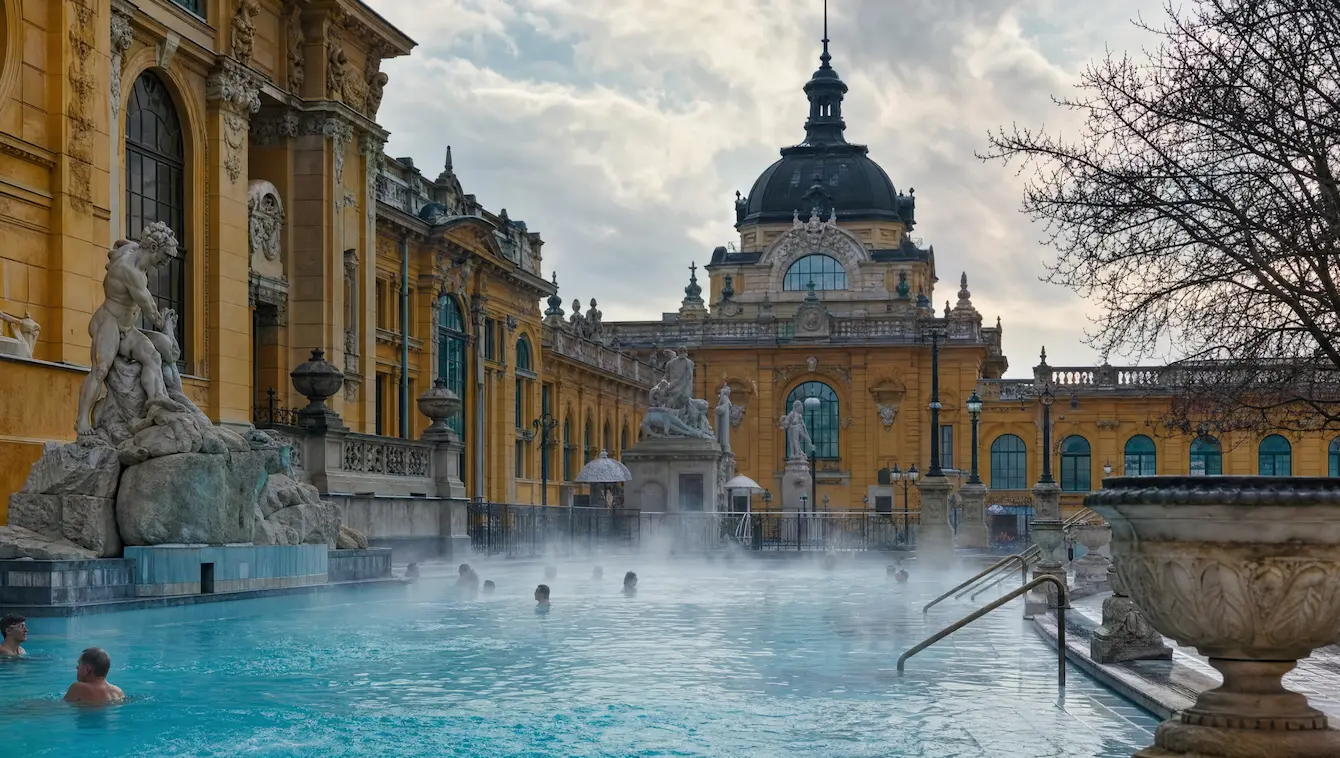
If you want the full thermal-spa ceremony, start in Budapest. The neo-baroque Széchenyi Bath opened in 1913 and is the largest medicinal bath in Europe, with 15 indoor and 3 outdoor pools fed by thermal wells of 74–76°C. The grand outdoor pools — a 27–28°C main pool and steaming 38°C hot pools where locals play chess — are the postcard image of European bathing. Weekday base entry starts from around 13,200 HUF (about €32–34); pre-booked fast-track tickets run from roughly €45–47, and prices rose about 5% from 7 January 2026.
Prices & tickets (2026)
- •Széchenyi weekday base entry: from ~13,200 HUF (~€32–34) — verify on the official site
- •Pre-booked fast-track: from ~€45–47 (bookable via GetYourGuide)
- •Rudas Baths (1566, Turkish dome + rooftop hot tub): the historic alternative
Skip-the-queue Széchenyi tickets are bookable via GetYourGuide.
Where to stay in Budapest (spa hotels)
- Ensana Thermal Margaret Island — 4★, score 9.1/10, from €151/night
- Danubius Hotel Helia — 4★, score 9.0/10, from €138/night
Indicative weekend rates for 2 adults — check live prices on Booking.com.
2Blue Lagoon, Iceland
Best for: Once-in-a-lifetime viewsMilky-turquoise geothermal seawater
Iceland's Blue Lagoon is the bucket-list bath. Set in a black-lava field on the Reykjanes peninsula, its silica-rich geothermal seawater glows milky turquoise and stays a blissful 37–39°C even when it snows. Pre-booking is mandatory — it sells out — and pricing is dynamic, so always check bluelagoon.com. The Comfort package starts from around ISK 11,990 (roughly €80–100+) and Premium from about €120+. For a cheaper, equally striking soak, the Sky Lagoon just 7 km from Reykjavik has a seven-step ritual, with the Saman pass from about ISK 13,990 (~€90–95).
Prices & tickets (2026)
- •Blue Lagoon Comfort: from approx. ISK 11,990 (~€80–100+) — verify on bluelagoon.com
- •Blue Lagoon Premium: from approx. €120+ (dynamic pricing)
- •Sky Lagoon (7 km from Reykjavik) Saman pass: from ~ISK 13,990 (~€90–95)
3Saturnia, Tuscany (Italy)
Best for: Free open-air soakingCascate del Mulino — thermal waterfalls
For the most romantic free soak in Europe, head to Saturnia in southern Tuscany. The Cascate del Mulino are open-air sulphurous thermal waterfalls that have carved a staircase of milky travertine terraces, kept at a steady 37.5°C year-round. They are free, open 24 hours, and need no booking — just a small parking fee may apply. Arrive at sunrise or after dark to beat the crowds. If you want loungers and treatments, the luxury Terme di Saturnia spa is 500 m away, from around €29 on weekdays and €39 at weekends (verify on termedisaturnia.it). A rental car is essential.
Prices & tickets (2026)
- •Cascate del Mulino waterfalls: free (small parking fee may apply)
- •Terme di Saturnia luxury spa: from approx. €29 weekday / €39 weekend — verify on termedisaturnia.it
4Bath, England (UK)
Best for: A rooftop city soakThermae Bath Spa — open-air rooftop pool
Bath is the only place in Britain you can bathe in naturally hot mineral water — and the modern Thermae Bath Spa does it in style, crowned by an iconic open-air rooftop pool at 33.5°C with views over the honey-coloured Georgian city. A weekday two-hour "Welcome" session is from approx. £44, or £49 anytime, including the rooftop pool and Wellness Suite (verify on the official site). The UNESCO-listed Roman Baths next door (built around 70 AD) are for sightseeing only — you can't bathe there — from £25 per adult. London Paddington to Bath is about 1h30 by train.
Prices & tickets (2026)
- •Thermae Bath Spa, 2h weekday "Welcome": from approx. £44 — verify official site
- •Thermae Bath Spa, anytime: from approx. £49 (incl. rooftop + Wellness Suite)
- •Roman Baths (UNESCO, sightseeing only — no bathing): from £25 adult
5Baden-Baden, Germany
Best for: Classic Roman-Irish ritualFriedrichsbad — the 17-stage bathing ritual
Baden-Baden is the elegant Black Forest spa town that gave the world the word "spa break". The historic Friedrichsbad (1877) offers a 17-stage Roman-Irish bathing ritual — a sequence of showers, hot rooms, soaks and a cold plunge taken without swimwear (mixed and single-sex days alternate, minimum age 14), from around €36, or about €49 with a massage. Prefer your swimsuit on? The modern Caracalla Therme has indoor and outdoor pools fed by springs of 28–42°C, with two hours from approx. €21, four hours €29 and a day pass around €35.
Prices & tickets (2026)
- •Friedrichsbad 17-stage ritual: from ~€36 (with massage ~€49), no swimwear, min age 14
- •Caracalla Therme (swimwear): 2h ~€21 / 4h ~€29 / day ~€35
6Pamukkale, Turkey
Best for: Wonder-of-the-world sceneryWhite travertine terraces + Cleopatra's Pool
Pamukkale — Turkish for "cotton castle" — is a UNESCO World Heritage cascade of blinding-white travertine terraces formed by calcium-bicarbonate water at around 35–36°C. Crucially, you cannot swim in the terraces themselves: bathing is limited to designated pools, and you must remove your shoes to walk on the formations. The real treat is Cleopatra's Antique Pool, where you can swim among submerged Roman columns in warm mineral water. Combined entry (terraces + the ancient city of Hierapolis + museum) is about €30, with Cleopatra's Pool an extra €6–8 (around €36–38 total).
Prices & tickets (2026)
- •Combined entry (terraces + Hierapolis + museum): ~€30
- •Cleopatra's Antique Pool: +€6–8 (total ~€36–38)
7Aix-les-Bains, France
Best for: Lakeside Alpine relaxationThermes Chevalley by Lac du Bourget
On the shore of France's largest natural lake, Lac du Bourget, Aix-les-Bains pairs Belle Époque charm with the French Alps. The Thermes Chevalley (run by ValVital) tap sulphurous sodium-rich water at about 37°C, and the Aqua-Détente leisure thermal area is open to everyone from around €22–25 per adult (a swim cap and flip-flops are required). It's open daily 10:00–19:00 with no reservation needed across the long 2026 season. Easy to reach by TGV from Paris in about three hours, it's a relaxed, less-touristy alternative to the big-name resorts.
Prices & tickets (2026)
- •Thermes Chevalley — Aqua-Détente leisure area: from ~€22–25 adult (cap + flip-flops required)
- •Open daily 10:00–19:00, no reservation; season ~24 Jan 2026 – 3 Jan 2027
Europe's best-value secret: Romania's thermal baths
If you only take one tip from this guide, take this one: Romania is the best-value thermal destination in Europe. The country sits on roughly one-third of the continent's mineral springs, yet day entry typically costs €8–€14 and spa hotels run far cheaper than Budapest, Iceland or the Alps — with smaller crowds. You can soak in a Roman-era spa town, float in a Dead-Sea-style salt lake, and visit Europe's largest wellness centre, all in one affordable trip.
Why Romania wins on value: over 8,500 mineral and thermal springs are catalogued here — about a third of Europe's total — covering everything from sulphurous and iodised waters to ultra-salty heliothermal lakes. For the full rundown, see our guide to the best thermal baths in Romania and our hot springs in Romania guide.
Here are three picks that capture exactly why Romania belongs on this list:
RO1Therme Bucharest
Europe's largest wellness centre — and a layover dream
At around 250,000 m², Therme Bucharest in Balotești is the largest wellness centre in Europe — bigger than anything in Budapest or the Alps — and it sits just 5 km from Bucharest's main airport, making it a genuine layover treat. Three zones cover every mood: Galaxy (family fun, 16 slides), The Palm (a tropical adults' retreat) and Elysium (premium saunas). The thermal pools sit around 33°C, and it's home to Europe's largest indoor botanical garden plus an urban beach. Entry runs from about 73 RON (~€14) for three hours up to roughly 193 RON (~€37) for a full day — a fraction of Western-European prices.
Prices (2026, EUR)
- •3h entry: from ~73 RON (~€14)
- •Full day: up to ~193 RON (~€37)
- •Hours: Mon–Thu 10:00–23:00, Fri–Sat 09:00–00:00, Sun 09:00–23:00 — tickets at therme.ro
RO2Băile Herculane
Europe's oldest documented spa (153 AD)
Older than any spa in Western Europe, Băile Herculane was founded by the Romans as Aquae Herculi Sacrae in 153 AD under Emperor Hadrian. Set deep in the dramatic Cerna Valley gorge, it has 16 springs ranging from 32°C to 62°C — sulphurous, sodium-chloride waters prized for skin and joints. The faded Habsburg-era grandeur (much of it under restoration) lends a romantic, time-capsule atmosphere you won't find at the polished Western resorts. The historic Apollo Baths cost around €3 to visit, and you can bathe for free in natural hot pools along the Cerna River.
Prices (2026, EUR)
- •Apollo Baths historic site: ~€3
- •Wild bathing on the Cerna River: free
RO3Sovata (Bear Lake)
The world's largest heliothermal salt lake
Formed in 1875, Bear Lake (Lacul Ursu) in Sovata is the world's largest heliothermal lake: its dense salt layers trap solar heat, so the deeper water is warmed to over 30°C even in spring. With roughly 250 g/L of salt — Dead-Sea-like — you float effortlessly, while the lakeside mud is a local therapy favourite. Entry is around 40 RON (~€8–9), and the bathing season runs from late June to early September, with a mandatory 13:00–15:00 break each afternoon. It's the kind of unique, low-cost experience that sums up why Romania punches above its weight.
Prices (2026, EUR)
- •Bear Lake entry: ~40 RON (~€8–9)
- •Bathing season ~late June–early September, with a 13:00–15:00 break
Where to stay in Bucharest (for Therme)
- The Marmorosch Bucharest, Autograph Collection — 5★, score 9.2/10, from €188/night
- Ramada Plaza by Wyndham Bucharest Convention Center — 4★, score 9.0/10, from €127/night (has a hot spring bath on site)
Indicative weekend rates for 2 adults — check live prices on Booking.com.
Practical info for visitors
When to go
Developed, indoor-and-outdoor baths like Széchenyi, the Blue Lagoon, Baden-Baden and Therme Bucharest are open year-round — and winter is genuinely magical, with steam rising as you sit in hot water surrounded by snow. Outdoor-only highlights are seasonal: Sovata's Bear Lake runs roughly late June to early September, while Pamukkale is best in spring (Apr–May) or autumn (Sep–Oct) to avoid Turkey's summer heat. For the Blue Lagoon and Saturnia, dawn and late evening are the quietest, most atmospheric times.
Prices & booking
Costs vary wildly across the continent. Iceland's Blue Lagoon is the priciest (from around €80–100+ and rising with dynamic pricing), Budapest and the Alps sit in the middle, and Romania is comfortably the cheapest, with entry from about €8–€14. The Blue Lagoon must be pre-booked and frequently sells out; Széchenyi fast-track and Pamukkale combo tickets are also worth reserving ahead. Saturnia's waterfalls and Aix-les-Bains need no booking at all. Always verify the latest prices on official sites, as thermal-spa tickets change often.
Etiquette & what to bring
- Bring a swimsuit, flip-flops and a towel (rentals exist almost everywhere but cost extra).
- A swim cap is required at some spas, including Aix-les-Bains — check on arrival.
- At Baden-Baden's Friedrichsbad, the Roman-Irish ritual is taken without swimwear (min age 14).
- At Pamukkale, remove your shoes on the terraces and bathe only in designated pools.
- Shower before entering, as at any European spa, and hydrate well in the hottest pools.
How to get there
Most of these destinations are an easy hop from a major airport or rail line:
- Budapest — Széchenyi is ~30–40 min from BUD airport (taxi €25–35, or the Airport bus + Metro M1 to Széchenyi fürdő in under an hour for about €5).
- Blue Lagoon — about 20 min from Keflavík (KEF) airport and 45 min from Reykjavik; many visitors stop on the way to or from the airport.
- Saturnia — ~2h30 from Florence (FLR) or ~2h from Rome (FCO); a rental car is essential.
- Bath — a 10-minute walk from Bath Spa station; London Paddington to Bath is about 1h30 by train, and Bristol Airport (BRS) is ~45 min away.
- Baden-Baden — Baden-Baden/Karlsruhe airport (FKB) is ~20 km, with fast ICE trains via Karlsruhe.
- Pamukkale — Denizli (DNZ) airport is ~1h away; Antalya (AYT) or Izmir (ADB) are ~3h.
- Aix-les-Bains — Geneva (GVA) ~1h15, Lyon (LYS) ~1h, or a direct TGV from Paris in ~3h.
- Romania (Therme Bucharest) — just 5 km from Bucharest airport (OTP), the easiest airport-to-spa hop in Europe.
Plan a Romanian thermal trip on the map
Ready to chase Europe's best value? Our interactive map of thermal baths in Romania shows every resort, waterpark and natural spring across the country — so you can see what's near your base and build a trip that fits your time and budget.
Go deeper: related guides
Planning a trip to Europe's best-value thermal destination? Start here:
- Best Thermal Baths in Romania (2026) — the top spa towns, prices in EUR and an interactive map.
- Hot Springs in Romania: Map, List & How to Visit — natural and wild springs across the country.
- Therme Bucharest Guide — tickets, the Galaxy/Elysium zones and airport transfers.
A note on treatments: the wellness and balneological benefits described here reflect traditional practice and are not medical advice. Hot mineral baths and CO₂ treatments have genuine contraindications — particularly for heart conditions, high blood pressure and pregnancy. If you're visiting for therapeutic reasons, consult your doctor or the resort's on-site medical staff first.
Frequently asked questions
Do I need to book the Blue Lagoon in advance?
Yes — pre-booking is mandatory. The Blue Lagoon does not sell tickets at the door and routinely sells out days or weeks ahead, especially in summer and around Christmas. Reserve a time slot on bluelagoon.com before you fly, as prices are dynamic and the cheapest entry windows go first.
Is Széchenyi in Budapest suitable for families?
Yes. Széchenyi is large, mostly outdoors and easy with children, with a warm 38°C pool and a cooler 27–28°C main pool. Note that the famous Gellért Baths are closed for renovation until 2028, so for a historic Turkish-style alternative choose Rudas (1566), which has a rooftop hot tub.
Is Romania's Therme Bucharest really comparable to top European spas?
On scale, yes — Therme Bucharest is the largest wellness centre in Europe at around 250,000 m², with thermal pools, 16 water slides and Europe's largest indoor botanical garden. It is open year-round, sits just 5 km from the airport, and costs from about €14, a fraction of Budapest or Iceland prices.
Can you actually swim in Pamukkale's white terraces?
No — bathing is only allowed in designated pools, not the protected travertine terraces, and you must remove your shoes to walk on them. For a proper soak, pay the small extra fee for Cleopatra's Antique Pool nearby, where you can swim among submerged Roman columns in warm mineral water.
Which European thermal destination is the best value in 2026?
Romania. It holds roughly one-third of Europe's mineral springs, yet day entry runs from about €8–€14 and spa hotels cost far less than Budapest, Iceland or the Alps. You get Roman-era spa towns, a Dead-Sea-style salt lake and Europe's biggest wellness centre — with smaller crowds.
Conclusion: where should you soak first?
Europe's best thermal baths cover every mood — Budapest for grand bathing culture, Iceland for a once-in-a-lifetime view, Saturnia for a free open-air soak, Bath and Baden-Baden for heritage, Pamukkale for sheer spectacle, and Aix-les-Bains for lakeside calm. But for the best mix of variety, atmosphere and price, Romania is the smart traveller's choice: Roman spa towns, a salt lake you float in, and Europe's largest wellness centre, all at a fraction of the cost.
Our tip: fly into Bucharest for Therme, then add a Roman soak in Băile Herculane or a weightless float at Sovata's Bear Lake — and use the interactive map to connect the dots.