Hot Springs in Romania: Map, List & How to Visit (2026)
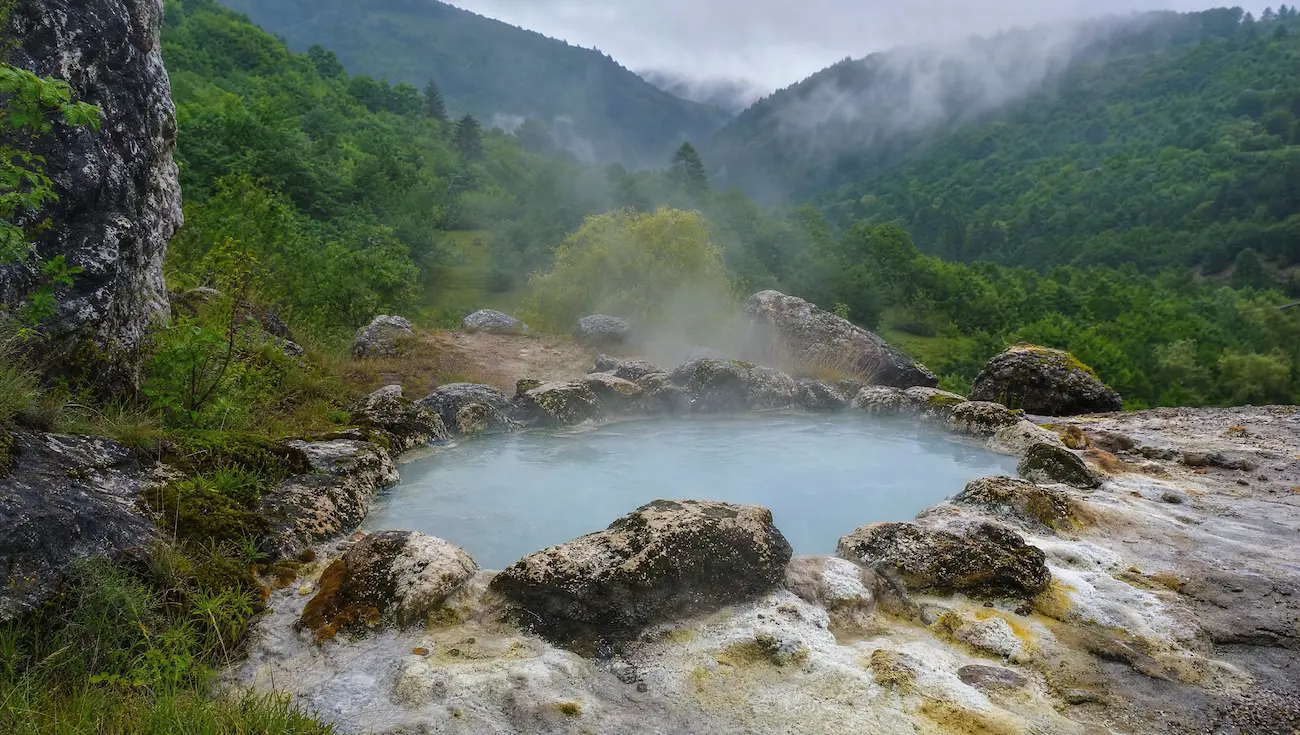
The hot springs in Romania are one of Eastern Europe's best-kept travel secrets: warm, mineral-rich thermal water bubbles up across the country, from Roman-era spa towns to open-air pools and a handful of genuinely wild springs. This guide maps out where Romania's hot springs are, how to reach them, what they cost in euros, and the honest truth about which ones you can actually bathe in.
Whether you want to soak in the historic baths of Băile Herculane, float in the geothermal pools near Oradea, or find a wild spring in the mountains, we've organised everything by region. You can also explore every thermal spot on our interactive hot springs map of Romania.
Romania's hot springs at a glance
| Hot spring | Region | Water temp | Entry (approx.) |
|---|---|---|---|
| Băile Herculane | Caraș-Severin (south-west) | 38–60°C at source | Museum ~€3 · pools vary |
| Geoagiu-Băi | Hunedoara (Transylvania) | ~34°C in pools | Entry ~€6 adult |
| Băile Felix | Bihor, near Oradea | 30–38°C pools | Aquapark ~€18/day |
| Băile 1 Mai | Bihor, near Oradea | Lake ~30–31°C year-round | Pools vary · reserve free to view |
| Tășnad | Satu Mare (north-west) | 72°C source → 36–40°C pools | ~€8 adult · ~€4 child |
| Sângeorz-Băi | Bistrița-Năsăud (mountains) | ~11–12°C (cold springs) | Public pavilions free |
What are Romania's hot springs?
Romania sits on a generous belt of geothermal aquifers, especially in the west and north-west of the country. Rainwater seeps deep underground, gets heated by the Earth's warmth, dissolves minerals along the way, and rises back to the surface as thermal springs. Depending on the location, the water can be sulphurous, bicarbonated, chlorinated, iodised or rich in CO₂ — each profile traditionally associated with different wellness uses.
The crucial thing to understand before you travel: the vast majority of Romania's hot springs have been developed into resorts and public pools. The water is pumped, channelled into bathing pools, and accessed via a ticket. Romania is not Iceland — there are no geyser fields or wild geothermal lagoons on every hillside. We'll cover the rare exceptions to this in the "wild springs" section below.
See them all on the map: our interactive map of thermal baths in Romania lets you filter springs by region, water type and facilities — handy for planning a route around the country.
Hot springs in Romania by region
Here are the country's most rewarding thermal destinations, each with how to get there, prices in euros and when to go.
1Băile Herculane
Caraș-Severin (south-west)Roman thermal resort + wild springs
Romania's oldest spa, founded by the Romans under Trajan in 102 AD and set inside the dramatic Cerna Valley gorge of Domogled-Valea Cernei National Park. Sixteen thermal springs feed chlorinated, bicarbonated, sulphurous and iodised waters that emerge at 38–60°C. The historic Apollo Baths are now a museum (~15 RON / ~€3, 09:00–19:00). For wild bathing, head ~8 km up the valley to '7 Izvoare' — free natural stone pools at 38–42°C with no facilities.
2Geoagiu-Băi
Hunedoara (Transylvania)Ancient Germisara · developed pools
Built on the ancient Roman site of Germisara (2nd century AD), this resort sits at 350 m altitude. There are two experiences: the free, open-air Roman thermal ruins (heritage only, no bathing) and the developed Băile Daco-Romane complex, with three thermal pools around 34°C, a children's pool and an Olympic pool from July. The sulphurous thermal water makes this one of Transylvania's most atmospheric soaks. Entry is 30 RON (~€6) adult, daily 09:00–18:00.
3Băile Felix
Bihor, near OradeaLargest year-round thermal resort
Romania's largest permanent thermal resort, 8 km south of Oradea. The geothermal water is oligomineral: weakly mineralised, below about 1 g/L, with small amounts of bicarbonates, sulfates and calcium. According to the Romanian Balneology Association it rises at 40–45°C and is cooled to 30–38°C in the pools. It is the country's most hotel-dense spa town and the easiest hot springs base if you fly into Oradea. The nearby Aquapark Nymphaea in Oradea offers a day pass for ~90 RON (~€18) adult / ~70 RON (~€14) child (09:00–22:00).
4Băile 1 Mai
Bihor, near OradeaQuiet resort + protected lotus reserve
The quieter twin of Băile Felix, sharing the same aquifer just 2 km away. Its claim to fame is the Pârâul Pețea Nature Reserve, home to the world-unique thermal water lily (Nymphaea lotus var. thermalis), a natural monument since 1931. The lake stays a constant ~30–31°C year-round and the lily blooms July–September. It is a strictly protected Natura 2000 site — you can admire it from outside, but bathing is not allowed. Aquapark Venus (opened 2023, six pools) handles the swimming.
5Tășnad
Satu Mare (north-west)Open-air geothermal strand
Home to one of Romania's hottest geothermal sources at 72°C, cooled to 36–40°C in the pools. The chlorinated-bicarbonated-sulphated sodium-calcium-magnesium water (~9.84 g/l) feeds the large open-air Ștrand Termal Tășnad. Entry is 40 RON (~€8) adult, 20 RON (~€4) child, under 6 free; after 16:00 on weekdays it drops to 25/15 RON. Open summer daily 08:00–22:00 (roughly May/June–September). It gets very crowded on summer weekends, so aim for a weekday morning.
6Sângeorz-Băi
Bistrița-Năsăud (mountains)Mineral drinking-cure resort
An important caveat for the list: Sângeorz-Băi is a historic mountain balneo-climatic resort, but it is NOT a hot-bathing destination. Its bicarbonate-chloro-sodic-calcium-magnesium mineral water is cold (~11–12°C) and rich in CO₂ — it is famous as a drinking cure (the bottled 'Hebe' water) and for mofette CO₂ inhalation, indicated for digestive, hepatobiliary and metabolic conditions. Warm baths exist only inside hotels using artificially heated mineral water. The public spring pavilions are free to visit.
Are there wild, free or natural hot springs in Romania?
This is the question we get asked most by international visitors, so here is the honest answer: genuinely wild, freely-accessible hot springs in Romania are rare. Most articles promising "natural hot springs" are actually describing developed resorts with ticketed pools. That said, a few real options exist:
- 1
"7 Izvoare" & "La Cădițe" (Băile Herculane): the closest thing to true wild bathing in Romania. Natural sulphurous water seeps into rough stone pools at ~38–42°C about 8 km up the Cerna Valley, inside the national park. It's free, but basic and sometimes poorly maintained — bring everything you need.
- 2
Pețea Creek & Lake (Băile 1 Mai): naturally warm at ~30–31°C, but strictly PROTECTED — it shelters the unique thermal water lily, so bathing is forbidden. Admire it, don't swim in it.
- 3
Warm Cerna River pockets: in places near Herculane, thermal water mixes into the Cerna River, creating naturally warmer spots — pleasant for a quick dip rather than a proper soak.
Myth-bust: Romania has no Iceland-style geysers or open geothermal lagoons. If a guide promises that, it's almost certainly describing a developed resort pool.
Natural springs vs. resort pools: which should you choose?
Both have their place. Wild springs like 7 Izvoare offer a raw, free, off-grid experience — but no changing rooms, no lifeguards, and variable cleanliness. Resort and aquapark pools (Felix, Tășnad, Geoagiu-Băi) deliver consistently warm, clean water, on-site facilities, restaurants and accommodation, in exchange for an entry fee and summer crowds. For most international visitors, a developed resort is the practical base, with a wild spring as a memorable side trip.
Practical tips: season, prices & what to bring
When to go
Open-air strands (Tășnad, Geoagiu-Băi's outdoor pools) are seasonal, roughly May/June to September, and busiest on July–August weekends — go on a weekday morning. Băile Felix and many hotel spas run year-round, making them the best winter option for a warm soak.
Prices in euros
Public pools are cheap by Western standards: ~€6 at Geoagiu-Băi, ~€8 at Tășnad, ~€18 for a full day at Aquapark Nymphaea. The Apollo Baths museum in Herculane is ~€3. Bring some RON cash, as smaller gates don't always take cards. Wild springs (7 Izvoare) are free.
What to bring
Swimsuit, flip-flops, towel, drinking water and sun protection. For wild springs add water shoes, a robe and a rubbish bag (leave no trace). A swim cap is required in some hotel indoor pools.
Where to stay near Romania's hot springs
Staying on-site or nearby lets you soak in the morning before the day-trippers arrive. Here are well-rated, real options at each main destination, with current guest scores and indicative nightly rates for 2 adults — always confirm live prices when booking.
We only list properties from our verified research.
Heading to a quieter mineral-spring base like Sângeorz-Băi? It has fewer large spa hotels, so it's best treated as a calm drinking-cure retreat — browse available stays there or use Bistrița as an alternative base.
Getting there: Cluj-Napoca airport is the best hub for the north-west springs (Tășnad, Felix, Geoagiu-Băi), Oradea airport is closest to Felix/1 Mai, and Timișoara is the gateway to Băile Herculane. A rental car gives you the most freedom, as several springs have limited public transport.
Frequently asked questions
Are there free or wild hot springs in Romania?
Mostly, no — almost all of Romania's hot springs are developed into ticketed resorts or public pools. The best genuinely free, wild option is the '7 Izvoare' (Seven Springs) area about 8 km up the Cerna Valley from Băile Herculane, where natural sulphurous water collects in rough stone pools at roughly 38–42°C. There are no facilities, so go prepared.
What is the difference between Băile Felix and Băile 1 Mai?
They sit only about 2 km apart and share the same geothermal aquifer near Oradea. Băile Felix is the larger, hotel-dense resort with big public pools, while Băile 1 Mai is quieter and home to the protected Pârâul Pețea reserve with its world-unique thermal water lily. You can swim at Felix; at 1 Mai the lily lake is protected and off-limits to bathers.
What is the thermal water lily at Băile 1 Mai?
It is the Nymphaea lotus var. thermalis, a Tertiary-relict water lily kept alive by the constant ~30–31°C water of the Pețea creek. It has been a protected natural monument since 1931 and is now inside a Natura 2000 reserve. You can view it from outside the reserve, but bathing in the lily lake is forbidden.
Which Romanian hot spring resort is best for families?
Băile Felix and neighbouring Băile 1 Mai are the top family choice. You get large warm pools, shallow children's pools, plus the modern Aquapark Nymphaea in Oradea (10 minutes away) and Aquapark Venus in 1 Mai, both with slides and play areas.
Do I need to book a hot spring in Romania in advance?
For public open-air pools and aquaparks you simply pay at the gate, though expect long queues on summer weekends — go on a weekday morning. Hotel spas and private thermal baths are worth booking ahead in peak season (July–August), especially at popular resorts like Geoagiu-Băi and Herculane.
Conclusion: planning your Romania hot springs trip
The hot springs in Romania reward travellers who plan a little: pick a developed resort like Băile Felix or Geoagiu-Băi as your warm, reliable base, then add a wild soak at Băile Herculane for the adventure. Cheap entry, year-round options near Oradea and a genuine sense of discovery make Romania one of Europe's most underrated thermal destinations.
Ready to map your route? Open the interactive thermal baths map and start planning.
Health note: thermal and mineral waters are traditionally associated with wellness benefits, but this article is for general information and is not medical advice. If you have a health condition, are pregnant, or plan a balneotherapy treatment, consult a doctor before bathing in or drinking mineral water.