Băile Herculane: Romania's Ancient Roman Spa Town Guide
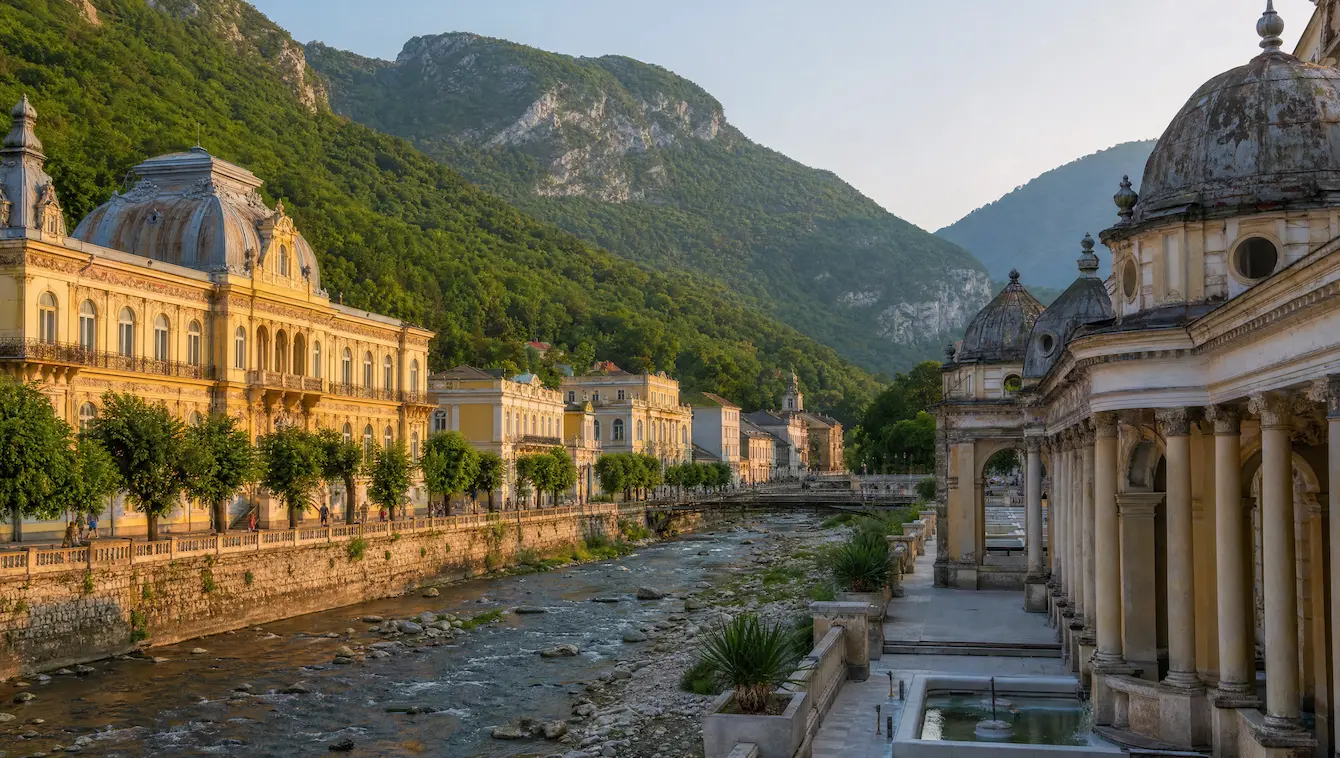
Băile Herculane is one of Europe's oldest spa towns — the Romans were already bathing in its steaming, sulphurous springs nearly 1,900 years ago, drawn here by the legend of Hercules. Tucked into the dramatic Cerna Valley gorge in south-west Romania, it blends Roman ruins, faded Austro-Hungarian grandeur and wild mountain scenery into one of the country's most atmospheric thermal destinations.
This guide covers everything an international visitor needs: the town's Roman story, its thermal baths and water types, the best things to do, how to get there, when to go and where to stay (with real prices in EUR). You can also see every spa in the country on our interactive thermal baths map, or jump straight to the dedicated Băile Herculane location page.
Băile Herculane at a glance
| Where | Cerna Valley, Caraș-Severin county, SW Romania |
|---|---|
| Founded | Roman era, ~102–153 AD (≈ 1,900 years old) |
| Water type | Sulphurous, chlorinated-sodic mineral water, 38–62°C |
| Best for | Heritage, nature & hiking, hotel spa breaks |
| Getting there | ~2.5h from Timișoara, ~2h40 from Craiova airport |
| Stays from | ~€67/night (rising to €170+ for top spa hotels) |
Why visit: a 1,900-year-old Roman spa
Herculane's story is its biggest draw. The town takes its name from the legend of Hercules bathing in its waters, and the Romans built a serious resort here. The first epigraphic mention dates to 153 AD ("Ad Aquas Herculi Sacras ad Mediam"), with foundations tied to Emperor Trajan around 102 AD. The spa flourished from roughly 107 to 267 AD, drawing Roman aristocracy who built temples and baths dedicated to Hercules, Aesculapius and Hygieia.
The second golden age came under the Habsburgs. Architect Wilhelm von Doderer redesigned the town, Emperor Franz Joseph called it "the most beautiful spa on the continent" in 1852, and Empress Elisabeth ("Sissi") had her own Villa Elisabeta here. The result is an open-air museum: around 74 classified historic monuments, grand 19th-century hotels, the Casino, the 1864 Stone Bridge and the magnificent Neptune Baths.
A note on expectations: Herculane is gorgeous but bittersweet. Much of the grand centre fell into disrepair after 1989. The famous Neptune Baths — ~4,000 m² with 63 bathing rooms and four red-marble pools — are closed to bathers, suffered partial collapses in 2019 and 2021, and were listed among Europe's 7 Most Endangered Heritage Sites in 2022. Volunteers from the Herculane Project run emergency conservation and occasional guided visits (check herculaneproject.ro). Come for the atmosphere and nature, and use a hotel spa for actual bathing.
The herculane thermal baths & water type
Herculane sits on 16–20 thermal mineral springs, and the water comes in three broad types. The most common is chlorinated-bicarbonated and slightly sulphurous (38.5–53.5°C); a second is chlorinated-bicarbonated and calcareous (46–56°C); and the strongest is chlorinated-brominated-iodised and sulphurous, reaching up to 62°C. The dominant active element is soluble sulphur — which is why the faint "rotten-egg" smell hangs in the air. It is completely normal and harmless.
So where can you actually bathe today? The historic public baths are mostly closed or now small museums, so your realistic options are:
- Hotel thermal pools — the most reliable choice. Diana, Afrodita and Thermae d'Olimpia all run indoor and/or outdoor thermal pools; some offer day passes (verify on arrival in peak season).
- Natural bathing in the Cerna River — free, year-round, where warm thermal water meets the river. The best-known spot is Șapte Izvoare Calde ("Seven Hot Springs"), about 7 km north, with informal riverside "la cădițe" pools at roughly 38–42°C.
- Apollo Baths Museum — now a small spa-history museum (walk-in, around 15 RON / ~€3).
- Venera Thermal Baths — generally open roughly 10:00–18:00 (price not officially listed, verify locally).
Medical disclaimer: Herculane's waters are traditionally associated with rheumatic and degenerative joint conditions, the peripheral nervous system, and gynaecological and dermatological complaints. This information is educational and is not medical advice or a promise of a cure. Thermal water this hot can affect your circulation and blood pressure. Before starting any course of balneotherapy — especially if you have a cardiovascular condition, are pregnant, or have a chronic illness — please consult a doctor or a qualified balneology specialist.
Things to do in & around Băile Herculane
What makes a trip here genuinely worthwhile is the mix of heritage and raw nature. Here is how to fill two or three days:
- Domogled–Valea Cernei National Park — at 612 km², this is the headline attraction: 33+ marked trails, over 700 caves, waterfalls and rich biodiversity, all free to explore.
- Șapte Izvoare Calde (7 km north) — natural hot springs right by the river. Free and a local favourite for a wild thermal soak.
- The historic centre walk — the Casino, Pavilion 1811, the 1864 Stone Bridge, the exterior of Villa Elisabeta, the Hercules Statue and the Izvorul Conteselor (Countesses' Spring).
- Neptune Baths exterior & Herculane Project tours — see the endangered masterpiece up close and support its restoration.
- Cerna Valley scenic drive or hike and Peștera Hoților (Thieves' Cave).
- The Dotto tourist train — seasonal (spring–September), around 20 RON / ~€4 for adults.
- Day trip to the Iron Gates / Cazanele Dunării — the spectacular Danube gorges, about 60 km south-east.
How to get to Băile Herculane
Herculane has its own CFR railway station in town, on the main Bucharest–Timișoara line, so it is easier to reach than you might expect for a mountain spa. Here are the three main gateways:
| From | By car | By train |
|---|---|---|
| Timișoara (TSR) | ~183 km / ~2.5h | ~3h45 (direct) |
| Craiova (CRA, Wizz Air) | ~160 km / ~2h40 | Connections via main line |
| Bucharest (OTP) | ~390 km / ~4–4.5h | ~6–7h |
The nearest towns are Orșova (~25 km) and Drobeta-Turnu Severin (~40 km). For maximum flexibility — and to reach the trailheads and Șapte Izvoare Calde — a hire car is the most convenient option, but the town centre itself is flat, compact and easily walkable.
When to visit
Herculane works year-round, but the season changes the experience. Summer (June–September) is peak and warmest — best for the national park, waterfalls and bathing in the Cerna River. Spring and autumn are ideal for hiking with fewer crowds and cooler, comfortable temperatures. Winter is quiet and atmospheric, best enjoyed from an indoor hotel spa. The hotel spas run all year; outdoor river bathing is best from roughly May to September.
What to pack: swimwear is mandatory at hotel spas, plus flip-flops and a towel (bring or hire). For the outdoors, add sunscreen, a light waterproof, hiking shoes and insect repellent in summer. The local currency is RON; EUR is accepted at hotels, and there is an ATM at Hotel Afrodita. Book treatments ahead in peak season.
Where to stay: best herculane hotels
Since the historic public baths are out of action, your hotel is where you will actually swim and soak — so it pays to choose well. These are the top-rated stays in town (guest scores and indicative nightly prices for two adults; rates fluctuate with season and demand):
1Pensiunea JOJO Imperial Resort & Spa
9.35-star · 385 reviews · Infinity, salt-water and indoor pools
The highest-rated stay in town and a genuine treat. This 5-star guesthouse pairs an infinity pool with a salt-water pool and an indoor pool, so the wellness side works in any season. Polished, modern and a clear step up from the resort's faded grand hotels.
2Pensiunea El Plazza
9.34-star · 232 reviews · Riverfront, indoor + outdoor pools
A 4-star riverfront favourite with both indoor and outdoor pools and the same excellent 9.3 guest score. The Cerna-side setting is a big draw, putting you within easy walking distance of the historic centre and the start of the valley trails.
3Bacolux Diana, Herculane
8.93-star · 2,081 reviews · Anchor wellness hotel, balneo base
The well-known Hotel Diana and the resort's anchor wellness hotel, with indoor and outdoor pools and a full balneotherapy base. With over 2,000 reviews and the best value on this list, it is the practical choice for a longer treatment-focused stay. There is an ATM at its sister hotel, Afrodita.
Two more strong options, depending on your travel style:
Thermae D'Olimpia & SPA – Adults Only 14+
8.9 · from €171Year-round indoor pool plus an open-air thermal bath. Adults-only (14+), so ideal for a quiet couples' break.
View on Booking.comBacolux Afrodita, Herculane
8.6 · from €96The well-known Hotel Afrodita: indoor and outdoor pools, a full spa and balneo base, a children's playground and an on-site ATM.
View on Booking.comExplore more on the map
Herculane is one of dozens of thermal destinations across Romania. Use our interactive map of thermal baths to plan a wider trip, or read the full Băile Herculane resort page for more local detail.
Frequently asked questions
Is Băile Herculane worth visiting in 2026?
Yes, if you arrive with realistic expectations. You get nearly 1,900 years of Roman and Austro-Hungarian heritage, the dramatic Cerna Valley gorge and working hotel spas. The grand historic centre is faded but atmospheric, and it pairs beautifully with hiking in Domogled National Park.
How old is Băile Herculane — is it really one of Europe's oldest spas?
The first Roman inscription dates to 153 AD, and Roman presence here goes back to roughly 102 AD under Emperor Trajan. That makes the spa around 1,900 years old and among the oldest continuously documented thermal resorts in Europe, founded around the legend of Hercules bathing in its waters.
How do I get from Timișoara to Băile Herculane?
By car it is about 183 km and 2.5 hours. There is also a direct train of roughly 3 hours 45 minutes to the in-town Băile Herculane station, which sits on the main Bucharest–Timișoara line. Craiova airport (served by Wizz Air) is another option at about 2 hours 40 minutes by car.
Are the thermal baths in Băile Herculane open year-round?
Hotel spas operate all year. The historic Neptune Baths are NOT open to bathers — the building is an endangered monument under emergency conservation. The natural thermal stretches of the Cerna River are accessible year-round, though they are most pleasant in the warmer months from May to September.
How hot is the water in Băile Herculane?
Depending on the spring, the thermal mineral water ranges from about 38°C to 62°C. It is sulphurous and chlorinated-sodic, so the faint rotten-egg smell is normal and harmless. If you have a cardiovascular condition, consult a doctor before intensive balneotherapy.
The verdict on Băile Herculane
Băile Herculane is a one-of-a-kind destination: a living Roman spa where you can soak in waters that Trajan's legions once knew, then hike straight into the Cerna Valley and Domogled National Park. The faded grandeur takes some emotional adjustment, but for travellers who love history, nature and a good thermal soak, few places in Europe match it.
Book a hotel with its own thermal pool, give yourself two or three days, and pair the soaking with a hike and a wander through the old centre. Then explore the rest of the country's springs on our thermal baths map.
Related reading
- Best Thermal Baths in Romania — the full country round-up with an interactive map.
- Hot Springs in Romania — natural and developed springs, region by region.
- Best Thermal Spa Hotels in Romania — where to stay for pools, treatments and value.
- Romania vs Hungary: Thermal Baths Compared — why Herculane is a great-value Budapest alternative.
- Hot Springs in Eastern Europe — Herculane in its wider regional context.