Romania vs Hungary: Thermal Baths Compared (Budapest Alternatives)
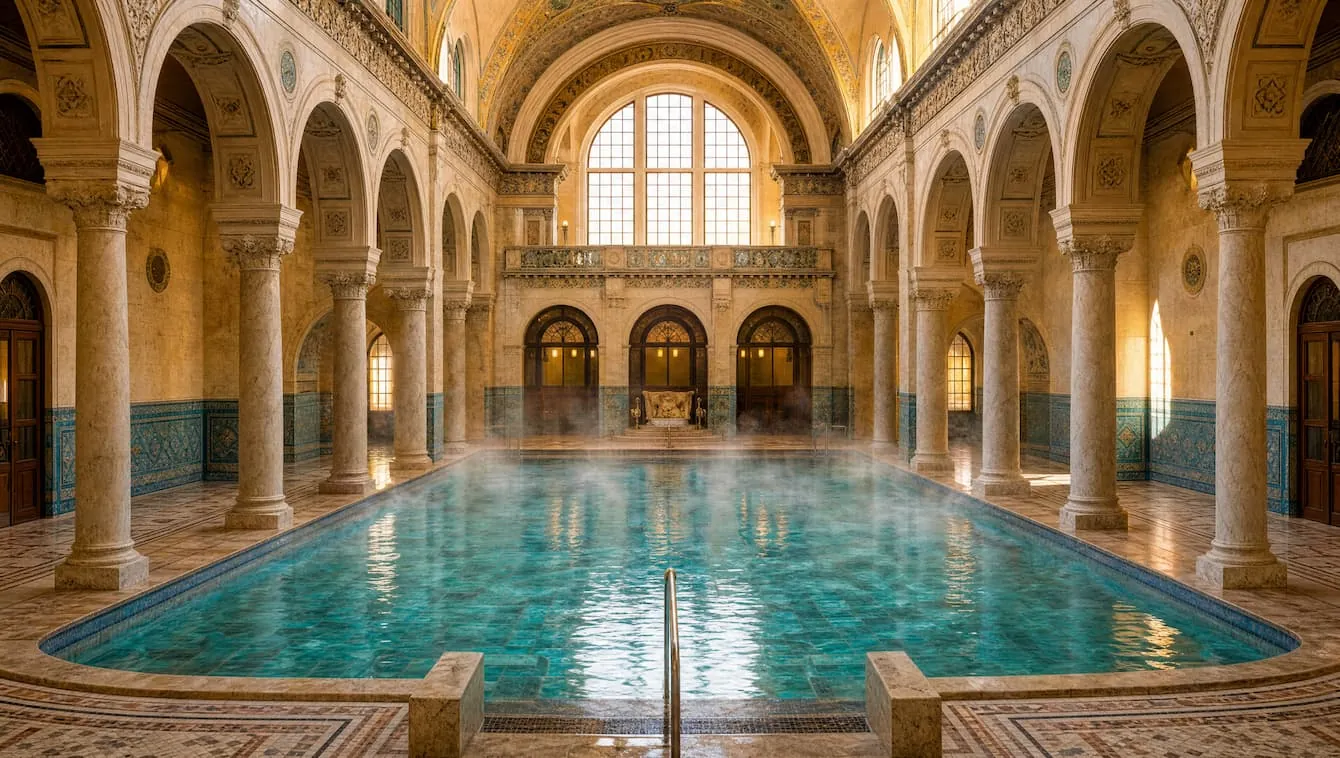
Budapest's grand bathhouses are world-famous — and rightly so. But if you're looking for a Budapest thermal baths alternative that's cheaper, far less crowded and packed with more variety, the country next door has a serious case to make. This is an honest Romania vs Hungary thermal baths comparison: where each country genuinely wins, real 2026 prices in EUR, and what's changed in Budapest that might just tip your trip across the border.
We'll be straight with you up front: Hungary still does some things better than Romania — the architecture, the walkable city baths, the effortless English. But two recent changes in Budapest (one bath closed until 2028, and a new ban on under-14s) have shifted the maths for a lot of travellers. By the end of this guide you'll know exactly when Hungary is the right pick, and when Romania's spas — from Therme Bucharest to Băile Herculane — are the smarter move. You can map them all on our interactive thermal baths map.
Two 2026 changes to know before you book Budapest: (1) the iconic Gellért Baths are closed for renovation (since 1 October 2025) and are not expected to reopen until around 2028. (2) Since August 2025, a city health rule bans children under 14 from Budapest's thermal baths, including Széchenyi. Both make Romania a stronger option for families and for anyone who had Gellért on their list.
The short answer: who wins on what
Short on time? Here's the honest, no-spin verdict before we dig into each side:
| If you want… | Better choice | Why |
|---|---|---|
| Grand architecture in one city | 🇭🇺 Hungary | Széchenyi's neo-baroque palace is hard to beat |
| Lowest prices | 🇷🇴 Romania | Entry from €5–€14; spa hotels from ~€40 |
| A family trip with kids | 🇷🇴 Romania | No under-14 ban; family waterparks |
| Fewer crowds / no queues | 🇷🇴 Romania | Big capacity vs Széchenyi's 45–60 min waits |
| Zero-car city break + nightlife | 🇭🇺 Hungary | Walkable baths, metro, the Saturday "Sparty" |
| Nature, history & wild bathing | 🇷🇴 Romania | Herculane's gorge + free riverside springs |
All prices in this guide were verified June 2026 and are shown in EUR for guidance (HUF and RON rates shift with the exchange rate, and bath operators change tariffs through the year). Always check the official site before you travel.
The Hungary side: Budapest's bathing heritage
Let's give Hungary its due. Budapest is the spa capital of Central Europe for good reason: dozens of springs bubble up beneath the city, the baths are genuinely grand, and you can reach them all on the metro without ever touching a car. For a culture-rich city break with thermal water woven through it, Budapest is superb — and we'd never tell you otherwise.
Széchenyi — the flagship
The Széchenyi Baths are the headline act: a vast neo-baroque palace from 1913 with 18 pools (3 outdoor, 15 indoor), outdoor water at 38–40°C and indoor pools up to 42°C. The chess players in the steaming open-air pool are a Budapest icon for a reason. It's open daily from 06:00 to 22:00 (pools generally close around 20:00 — verify on the day), the BUD airport is about 30 minutes away by metro or taxi, and Metro M1 drops you right at "Széchenyi fürdő".
The catch is popularity. Széchenyi is overwhelmingly full of international tourists, and weekend queues can run 45–60 minutes. On Saturday nights it transforms into the famous "Sparty" — a thermal pool party with lights and DJs (around €59), which is brilliant fun if that's your scene and a no-go if it isn't.
Széchenyi prices (2026, verified June 2026)
- •Cashier, weekday: 13,200 HUF (~€33) locker / 14,200 HUF (~€35) cabin
- •Cashier, weekend: 14,800 HUF (~€37) locker / 15,800 HUF (~€39) cabin
- •Online skip-queue: ~€49–€53 weekday / €53–€59 weekend
- •Early-morning (before 9am): from 10,500 HUF (~€26) · "Sparty" Sat night ~€59
Prices rose from 1 May 2026 and remain dynamic — confirm on szechenyibath.hu.
Booking tickets: Széchenyi summer slots regularly sell out, so pre-booking is recommended. Entry is commonly bought through GetYourGuide or the official szechenyibath.hu site — the online rate is pricier than the cashier but lets you skip the queue.
Gellért — closed until ~2028
Here's the one that catches travellers out. The breathtaking Gellért Baths, an Art Nouveau masterpiece from 1918, closed on 1 October 2025 for a full renovation and are not expected to reopen until around 2028. If a guide or old blog post still sends you to Gellért for 2026, it's out of date — the baths simply aren't available right now.
Rudas — the active historic alternative
With Gellért shut, the best historic soak in Budapest is the Rudas Baths: an Ottoman-era bathhouse with a domed Turkish pool and a much-photographed rooftop pool overlooking the Danube. Entry runs roughly 7,000–9,000 HUF (~€17–€23), and it's a lovely, more atmospheric option than the tourist crush at Széchenyi. Note that some Rudas sessions are still single-sex on certain weekdays — check the schedule before you go.
Where to stay for a Budapest spa break
- Ensana Thermal Margaret Island Health Spa Hotel — 4★, score 9.1/10, from €151/night. On Margaret Island, with thermal pools on site.
- Danubius Hotel Helia — 4★, score 9.0/10, from €138/night. Danube-side thermal spa hotel.
Indicative weekend rates for 2 adults — check live prices on Booking.com.
See all spa stays in BudapestWhere Hungary genuinely wins: walkable city baths you can reach on the metro, grand and iconic architecture, an easy hub airport (BUD, served by Wizz, Ryanair and easyJet), and excellent English everywhere. For a single-city culture-and-spa break with no car needed, Budapest is still the stronger overall experience.
The Romania side: a serious Budapest thermal baths alternative
Romania doesn't try to out-Budapest Budapest — it offers something different. More space, far lower prices, and a much wider menu: a giant modern wellness resort, Europe's oldest spa town set in a mountain gorge, and family-friendly geothermal lakes. Here are the three picks that work best as a Budapest alternative.
Therme Bucharest
Best for: families & airport stopoversEurope's largest wellness centre
Think of Therme as the modern counterpoint to Széchenyi's history. It has 27 pools, 10 saunas, a salt library and tropical gardens under glass, with water from 32–40°C. And here's the kicker for travellers: it sits in Balotești, just 5 km from Bucharest's OTP airport (~15 min) — easier to reach from your plane than Széchenyi is from central Budapest, which makes it a brilliant layover treat. Zones split into Galaxy (all ages), The Palm (14+) and Elysium (14+, with full access, saunas and a mineral pool).
Prices (2026, EUR — verify on therme.ro)
- •Galaxy: 3h ~€14–18 / full day ~€20–26
- •The Palm: full day ~€30–40 (Mon–Fri morning special ~€15 / 3.5h)
- •Elysium: full day ~€34–44 · evening specials Mon–Thu from ~€13–25
- •Towel ~€5, flip-flops ~€5 · cashless wristband, English website & signage
Therme Bucharest tickets: entry isn't sold through hotels. Buy direct at therme.ro (this avoids any platform markup), at the gate, or pair it with a transfer via an activities platform. The official site is fully in English with cashless wristbands.
Where to stay near Therme Bucharest
- Ramada Plaza by Wyndham Bucharest Convention Center — 4★, score 9.0/10, from €127/night. Hot spring bath + open-air bath on site, near Therme.
- Crowne Plaza Bucharest by IHG — 4★, score 9.0/10, from €152/night. Polished 4★ base in the north of the city.
Indicative weekend rates for 2 adults — check live prices on Booking.com.
See all stays in BucharestBăile Herculane
Best for: history, nature & budgetEurope's oldest documented spa (153 AD)
If Budapest's history appeals to you, Herculane goes back even further. Set in a dramatic Carpathian gorge on the Cerna River, it has been a spa since Roman times — almost 2,000 years. The 19 thermo-mineral springs (sulphurous, sodium-chloride, bicarbonate, bromine and iodine, 38–60°C at source) feed hotel spas, and you can bathe for free in the natural riverside "cădițe" — wild stone pools right by the water. The Habsburg-era buildings are in a state of romantic, faded grandeur (some under restoration), which is part of the atmosphere. English is moderate but improving, and a car is needed.
Băile Felix
Best for: families & cheap waterparksRomania's largest year-round spa resort
This is the family answer to Budapest's under-14 ban. Just 8 km from Oradea, Felix is Romania's biggest year-round resort, built around Lotus Lake — an open-air geothermal lake that stays around 34°C all year. The oligomineral water, weakly mineralised with small amounts of bicarbonates, sulfates and calcium, rises at 40–45°C and fills pools kept at 34–40°C, and the Apollo-Felix waterpark costs around 25 RON (~€5) to enter (verify locally). Crucially, there's no under-14 ban here — kids are welcome. The OMR airport is just ~12 km away, with Wizz Air flying in from London Luton.
Resort hotels — including Lotus Therm 5★, Hotel Termal 4★ and Hotel International — typically run ~€50–€120/night with pool access included, a fraction of Budapest spa-hotel rates.
Romania vs Hungary spa: the full comparison
Here's the head-to-head across the dimensions that actually decide a trip. Read it as four columns: Budapest on one side, three Romanian options on the other.
| Dimension | Budapest (Széchenyi / Rudas) | Therme Bucharest | Băile Herculane | Băile Felix |
|---|---|---|---|---|
| Entry (adult) | €33–39 cashier / €49–59 online | €14–37 by zone/duration | Free (wild) / €5–20 hotel spa | ~€5 Apollo (verify) |
| Spa hotel / night | €138–310 | €127–305 | €40–80 | €50–120 |
| Crowds | Very high (45–60 min queues) | Moderate (large capacity) | Low–moderate | Low–moderate |
| Variety | Thermal pools, Sparty, architecture | Slides, saunas, salt therapy, tropical | Wild bathing, history, gorge, balneo | Thermal lake, waterpark, balneo |
| Architecture / atmosphere | Grand neo-baroque, iconic | Modern wellness resort | Habsburg ruins + gorge (romantic decay) | Functional resort, gardens |
| Access / flights | Excellent (BUD hub) | Good (OTP 5 km from Therme) | Moderate (TSR/CRA + ~2.5h drive, car) | Good (OMR ~12 km) |
| English | Excellent | Very good | Moderate | Moderate |
| Kids under 14 | Banned (city rule, Aug 2025) | Welcome (Galaxy zone) | Welcome | Welcome |
| Best for | Architecture lovers, party-goers, city break | Families, airport stopover, full-day resort | History/nature, budget wild bathing | Families, health tourists, budget |
Figures verified June 2026. HUF/RON rates and bath tariffs change through the year — confirm on the official sites before booking.
When to choose Hungary, and when Romania
No spin here — both are great, just for different trips. Use this to decide.
Choose Hungary if…
- •You want a genuine city break with major sights, restaurants and nightlife alongside the baths.
- •Grand, iconic architecture is the whole point of your soak.
- •You don't want to rent a car — everything is on the metro.
- •The Saturday "Sparty" is on your bucket list.
- •You value effortless English and a one-city, low-friction trip.
Choose Romania if…
- •You want lower prices on both entry and hotels.
- •You're travelling with children under 14 (no Budapest-style ban).
- •You'd rather skip 45–60 minute queues and have more space.
- •You crave variety — salt lakes, dry CO₂ mofettes, gorges and nature.
- •You have an OTP layover (Therme is 5 min away) or want 2,000 years of history at Herculane.
The honest caveat: outside of Therme Bucharest and the top resort hotels, Romania's infrastructure is less polished than Budapest's, English varies in smaller resorts, and you'll often need a car. For pure atmosphere, walkability and culture concentrated in a single city, Budapest remains the stronger one-city experience. Romania wins on price, variety of water and nature, and uncrowded authenticity.
Go deeper: Romania's top thermal picks
If Romania has won you over, these guides have the full detail to plan it:
- Best Thermal Baths in Romania (2026) — the full hub, with six destinations, prices and a map.
- Therme Bucharest Guide — tickets, the Galaxy / Palm / Elysium zones and airport transfers in detail.
- Băile Herculane Guide — Romania's ancient Roman spa town, and how to find the free wild pools.
See every Romanian thermal bath on the map
Planning a Budapest trip but tempted to cross the border? Our interactive map of thermal baths in Romania shows every resort, waterpark and natural spring, so you can see what's near your route — Felix and Oradea are an easy add-on from Hungary by car, for instance.
Travelling with kids? Budapest's under-14 ban (since August 2025) is the single biggest reason families now look across the border. Both Therme Bucharest's Galaxy zone and Băile Felix's waterpark welcome children, making Romania the family-friendly Budapest alternative for 2026.
Frequently asked questions
Are Romanian thermal baths cheaper than Budapest?
Generally, yes. A full day at Széchenyi runs about €33–€39 at the cashier, or €49–€59 if you pre-book online to skip the queue. In Romania, Therme Bucharest starts around €14 for a 3-hour Galaxy pass, and spa hotels in Felix or Herculane cost roughly €40–€120 a night versus €138–€310 in Budapest. Prices are dynamic, so verify the official sites before you travel.
Is Gellért Bath open in 2026?
No. The Art Nouveau Gellért Baths closed on 1 October 2025 for a full renovation and are projected to reopen around 2028, so they are not available in 2026. If you want a historic Budapest soak, head to the Ottoman-era Rudas Baths (with its famous rooftop pool) instead, from roughly €17–€23.
Can families with children use Budapest thermal baths?
Since August 2025, a Budapest city health rule bans children under 14 from the city's thermal baths, including Széchenyi. If you're travelling with younger kids, Romania is the more family-friendly choice: Therme Bucharest's Galaxy zone welcomes all ages, and Băile Felix has a family waterpark with no under-14 ban.
Do I need to speak Hungarian or Romanian?
No. English is spoken excellently across Budapest's baths, hotels and metro. In Romania, Therme Bucharest has full English signage, a website and cashless wristbands, and English is very good in Bucharest. In smaller resorts like Băile Herculane and Băile Felix, English is moderate but improving — a translation app helps for the occasional gap.
Is Romania easy to reach from Western Europe for a spa trip?
Yes. Budget carriers fly into Bucharest (OTP) — and Therme is just 5 km from the airport, around 15 minutes away. Wizz Air also flies from London Luton to Oradea (OMR), which is only about 12 km from Băile Felix. For Băile Herculane you'll fly to Timișoara or Craiova and drive roughly 2.5 hours, so a car is needed there.
A note on treatments: any therapeutic uses mentioned here reflect traditional and balneological practice and are not medical advice. Mineral waters and treatments have genuine contraindications — particularly for heart conditions, high blood pressure and pregnancy. If you're visiting for treatment, consult your doctor or the resort's on-site medical staff first.
Conclusion: your honest bottom line
If you're set on a classic city break with grand architecture and zero hassle, Budapest is still wonderful — just know that Gellért is closed until around 2028 and kids under 14 can't bathe. But if you want a real Budapest thermal baths alternative that costs less, has shorter queues and offers far more variety, Romania delivers: a quick OTP-airport soak at Therme Bucharest, 2,000 years of history and free wild bathing at Băile Herculane, or a budget family week at Băile Felix.
Our tip: if you're already flying to Budapest, consider tacking on Felix and Oradea — they're an easy drive from the Hungarian border. Start mapping it on our interactive map.