Salt Lakes & Salt Baths in Romania: Where to Float & Heal
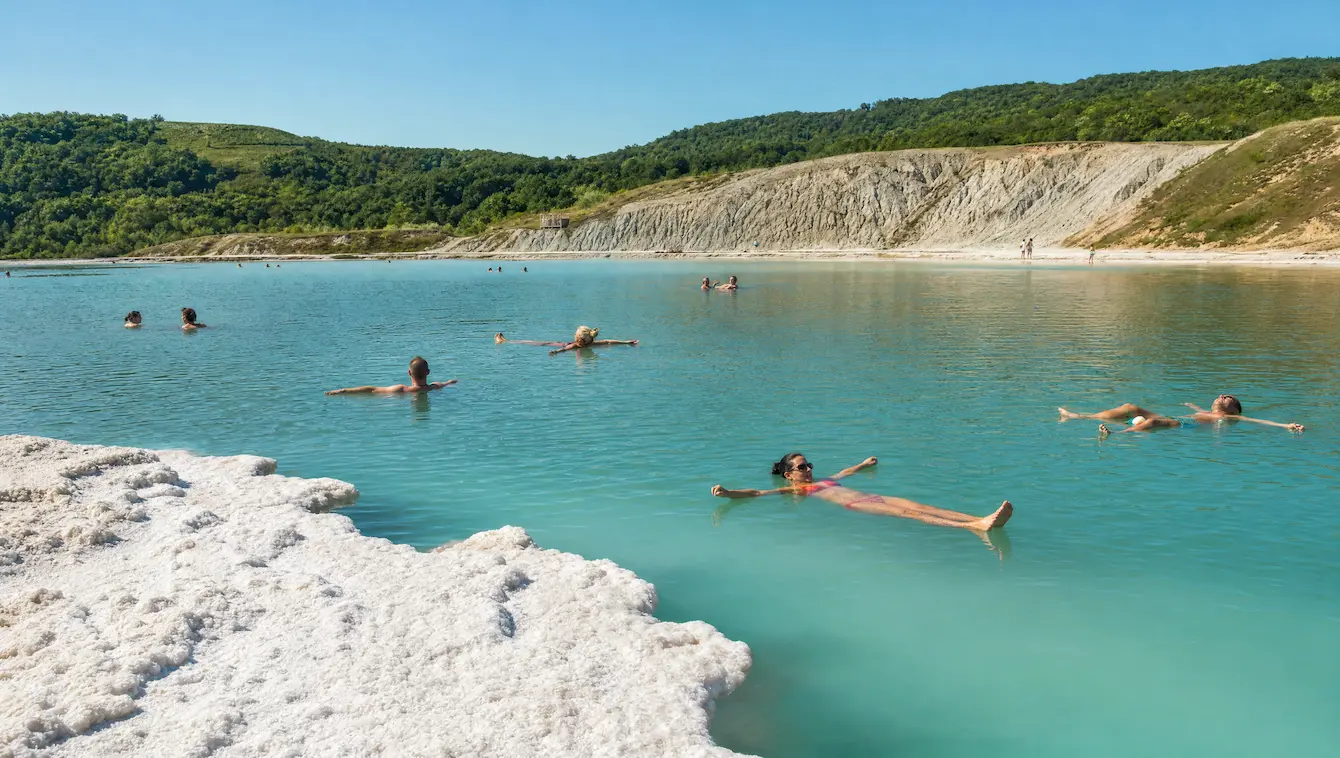
The salt lakes in Romania let you do something most travellers only associate with the Dead Sea — lie back, lift your feet, and float without lifting a finger. From the warm heliothermal depths of Sovata's Bear Lake to the jet-black healing mud of Techirghiol, the country has a remarkable spread of salt-water lakes, several of them even saltier than the Dead Sea itself, and almost all of them refreshingly cheap to visit.
This guide walks through the six best salt lakes and salt baths in Romania for 2026 — what makes each one special, how salty the water is, how to visit, entry prices in EUR, the right season, and where to stay. You can also see them all on our interactive map of Romania's thermal and salt baths.
What makes Romanian salt lakes special
Three quirks of physics and chemistry set these lakes apart, and they explain almost everything you'll feel when you step in.
1. Heliothermal heating — sun-warmed salt water
A heliothermal lake heats itself with sunlight. A thin layer of fresh water (from streams and rain) floats on top of the much denser salt water below. That freshwater layer acts like the glass roof of a greenhouse: sunlight passes straight through it and warms the salty water beneath, but the heat can't escape back up. The result is striking — water at 1.5–2 m down can reach 35–40°C with no heating at all. Sovata's Bear Lake is the world's most famous example.
2. Dead-Sea buoyancy — you float, you can't swim
The more salt is dissolved in water, the denser it becomes, and the more it pushes you up. At depth, Romania's salt lakes run from about 220 g/L (Sovata) all the way to 415 g/L at Ocna Sibiului — compared with roughly 280–300 g/L in the Dead Sea. At those concentrations you bob like a cork. Floating on your back is easy and oddly meditative; proper swimming is basically impossible.
3. Sapropelic mud — the dark healing sediment
Many of these lakes have a layer of sapropelic mud on the bed — a dark, organic-rich sediment made of smectite clay, sulphur and trace elements. It holds heat well and has been used in traditional pelotherapy (mud therapy) for generations. The classic ritual is to coat your skin, dry the layer in the sun, and rinse it off. Techirghiol's mud is so prized that locals call it "Black Gold".
In short: a salt water lake in Romania can warm itself with the sun (heliothermal), hold you up like the Dead Sea (high salinity), and offer mineral mud for the skin (sapropelic). Few places in Europe pack all three into lakes you can visit for the price of a coffee.
At a glance: Romania's salt lakes compared
Short on time? This quick-pick table helps you decide where to head first:
| Lake | Why go | Salinity (deep) | Entry |
|---|---|---|---|
| Sovata (Bear Lake) | Warm heliothermal float | 220–300 g/L | ~€8 |
| Techirghiol | Black "Black Gold" mud | ~80–90 g/L | ~€3–4 |
| Ocna Sibiului | Saltier than the Dead Sea | up to 415 g/L | ~€7 |
| Turda (Durgău) | Lakes + a salt mine | up to 28% (~280 g/L) | ~€5 |
| Ocna Șugatag | Brine + Maramureș culture | ~119 g/L | ~€8–10 |
| Amara | Closest to Bucharest | Bromide mineral | Verify |
Prices shown in EUR for guidance; RON rates can shift slightly with the exchange rate, and several figures are approximate or historical. Always check the official site before you travel.
The 6 best salt lakes & salt baths in Romania
Here are our top picks, each with the practical details you actually need — salinity, prices in EUR, how to visit, the right season, and a few hand-picked places to stay nearby.
1Sovata — Bear Lake (Lacul Ursu)
Best for: A warm heliothermal floatThe world's largest heliothermal lake
Bear Lake (Lacul Ursu) is the star of the Romanian salt lakes and the largest heliothermal lake on the planet. Covering about 4 hectares and 18 m deep, it has welcomed bathers since 1876. The surface water sits near 100 g/L of salt, rising to 220–300 g/L in the depths, where the trapped heat pushes the temperature past 35°C in summer. You float without effort, and many Sovata spa hotels pipe the lake's salt water into their own pools.
How to visit & prices (2026, EUR)
- •Daily 10:00–18:00 with a mandatory 13:00–15:00 break
- •Single-entry tickets; entry ~40 RON (~€8) adult, ~30 RON (~€6) child/senior (approximate/historical — verify on lacul-ursu.ro)
- •No footwear in the lake; shower before and after; strong UV, so bring sun protection
Where to stay near Sovata
- Fabesca Boutique Hotel & SPA — 4★, score 9.4/10, from €160/night (hot-spring bath + salt-water pool)
- Vila Intre Lacuri — 3★, score 9.9/10, from €187/night (salt-water pool, best-rated in the area)
- HOTEL CRYSTAL WELLNESS & SPA (Superior) — 4★, score 9.7/10, from €381/night (full wellness centre)
Indicative weekend rates for 2 adults — check live prices on Booking.com.
2Techirghiol
Best for: Black sapropelic mud therapyThe Black Sea coast's "Black Gold" mud lake
Techirghiol, just inland from Eforie Nord, is famous for its jet-black sapropelic mud — locals call it "Black Gold". A Ramsar-listed wetland, the brackish chlorosodium lake holds around 80–90 g/L of salt and is rich in magnesium, bromine, calcium, potassium and manganese, with a mud layer roughly 0.6 m thick over about 98 hectares. Visitors scoop the mud, smear it on, let it dry in the sun for 20–30 minutes, then rinse. The water is too salty for real swimming.
How to visit & prices (2026, EUR)
- •Self-application: scoop the mud, dry 20–30 min in the sun, rinse off
- •Historic public cost ~15–20 RON (~€3–4) — verify current 2026 rates locally
- •Ana Hotels Europa in Eforie Nord runs a year-round Techirghiol mud and water medical spa
Where to stay near Eforie Nord
- Ana Hotels Europa Eforie Nord — 4★, score 9.1/10, from €377/night (specialist Techirghiol mud therapy)
- STEAUA DE MARE - Eforie Resort — 4★, score 9.3/10, from €137/night (aqua spa, great value)
- Mirage Medspa Hotel — 4★, score 9.0/10, from €287/night (medical spa focus)
Indicative weekend rates for 2 adults — check live prices on Booking.com.
3Ocna Sibiului
Best for: The saltiest float in EuropeLakes saltier than the Dead Sea, 14 km from Sibiu
A cluster of salt lakes 14 km from Sibiu, Ocna Sibiului formed when old salt mines collapsed and filled with brine. Lake Brâncoveanu, the Red Lake and the Black Lake are among the saltiest in Europe — up to 415 g/L, which is even more concentrated than the Dead Sea. There's a natural black-mud spring on site too. The resort has been upgraded with showers and around 600 parking spaces, and pairs perfectly with a base in Sibiu's beautiful medieval centre, a 15-minute drive away.
How to visit & prices (2026, EUR)
- •Daytime price ~35 RON (~€7) adult full day, ~20 RON (~€4) after 18:00 (2025 figures — verify on sibiu-turism.ro)
- •Summer outdoor bathing plus indoor brine baths
- •Natural black-mud spring on site; showers and parking available
Where to stay near Sibiu
- Hilton Sibiu — 5★, score 8.6/10, from €231/night (Sibiu, 15 min drive)
- Hotel Imparatul Romanilor Hotel & SPA — 4★, score 8.5/10, from €332/night (historic Sibiu landmark)
Indicative weekend rates for 2 adults — check live prices on Booking.com.
4Turda — Durgău Lakes & Salina Turda
Best for: Lakes plus an underground salt mineDead-Sea-like brine beside a spectacular salt mine
Turda gives you two experiences in one. The Durgău-Valea Sărată salt lakes have around 10% salt at the surface, climbing to a Dead-Sea-like 28% at 30 m depth, so the float is intense. Next door, the world-famous Salina Turda salt mine is a vast underground attraction with a lake, a Ferris wheel and a spa-like microclimate. The lakes are best in summer; the mine is a great all-weather backup if the day turns cool.
How to visit & prices (2026, EUR)
- •Durgău (verified June 2026): adult 25 RON (~€5), child/student/retiree 15 RON (~€3), under 3 free; 7-day pass 150/90 RON; cheaper after 17:00
- •Salina Turda mine: adult 75 RON weekday / 90 RON weekend (~€15–18), seniors 50/60, children 3–18 48/59; daily 09:00–17:00 (last entry 16:00)
- •Online tickets for the mine at salinaturda.eu
Where to stay near Turda
No standout single property is listed for Turda in our data, so browse the full set of nearby stays and pick the spa that suits you.
5Ocna Șugatag
Best for: Concentrated brine in MaramureșEight salt lakes plus heated indoor pools
In the folk-culture heartland of Maramureș, Ocna Șugatag has eight salt lakes that formed on collapsed mine sites — Lake Gavril is 30 m deep, Tăul fără fund (the "bottomless pool") reaches 33 m. The water is around 119 g/L, very concentrated for an open-air lake. The treatment centre adds heated indoor salt-water pools at 36–37°C, electrotherapy, massage and paraffin, and many local guesthouses have their own private salt-water pools. It's best enjoyed over a few days alongside the painted villages, wooden churches and monasteries of the region.
How to visit & prices (2026, EUR)
- •Indoor pools year-round 09:00–20:00; outdoor lakes summer 08:00–20:00
- •~40–50 RON (~€8–10) adult weekday, 50–60 RON weekend; child 5–14 25–35 RON; 5-day pass ~200 RON; under 5 free (verify on-site)
- •Treatment centre offers electrotherapy, massage and paraffin alongside the salt pools
Where to stay near Ocna Șugatag
No standout single property is listed for Ocna Șugatag in our data, so browse the full set of nearby stays and pick the spa that suits you.
6Amara
Best for: The easiest salt lake from BucharestMineral water and mud baths near the capital
Amara is a saline liman lake just 7 km from Slobozia and about 1h30 from Bucharest by road, making it the most accessible salt lake from the capital. Its chloro-sulphate-bromide mineral water and sapropelic mud (roughly 40% organic, 41% mineral) feed open-air beach mud baths and the treatment centres of Hotel Ialomița (480 beds) and Hotel Parc. Romanian balneology traditionally links the resort to rheumatism, peripheral nerve issues, post-trauma recovery of the locomotor system and gynaecological care.
How to visit & prices (2026, EUR)
- •Year-round hotel treatments; the outdoor beach mud baths are seasonal (Jun–Sep)
- •2026 beach fees and opening hours are not confirmed — verify on tratamentbalnear.ro or with Complex Hotelier Ialomița
- •Treatment centres at Hotel Ialomița and Hotel Parc
Where to stay near Amara
No standout single property is listed for Amara in our data, so browse the full set of nearby stays and pick the spa that suits you.
Heading to Sovata? Our dedicated Sovata & Bear Lake guide goes much deeper on tickets, the bathing season, the spa hotels and how to combine it with the rest of Transylvania.
A word on the health benefits
Romania has a 150-year tradition of balneology — the medical use of mineral waters and muds — and parts of it are still covered by the national health system. Salt water and sapropelic mud are traditionally associated with musculoskeletal and rheumatic complaints, certain skin conditions (such as psoriasis and eczema), peripheral neurological issues, gynaecological care, and general circulation and relaxation.
Treat these as traditional, balneological uses rather than guaranteed cures — results vary from person to person, and the strong UV and salinity at these lakes are not for everyone.
Medical disclaimer: the benefits described here reflect traditional Romanian balneology, not medical advice, and are not a substitute for seeing a doctor. Salt-water bathing and mud therapy have genuine contraindications — if you have a skin condition, cardiovascular disease, high blood pressure, or you are pregnant, consult your doctor or the resort's on-site medical staff before bathing or taking treatments.
See every salt lake on the map
Want to build your own route? Our interactive map of thermal and salt baths in Romania shows every lake, resort and spring across the country, so you can see what's near your base and connect two or three in a single trip — Ocna Sibiului with Sibiu, say, or Turda with Cluj.
How to reach the salt lakes
The lakes are spread across the country, so your gateway depends on which ones you're after:
- Cluj-Napoca (CLJ) — the central hub for Transylvania: Turda (~35 km), Sovata (~1.5h) and, further north, Ocna Șugatag in Maramureș (~2h30).
- Sibiu (SBZ) — Ocna Sibiului is just 14 km away, an easy half-day from the medieval city centre.
- Constanța (CND) — closest to Techirghiol (~30 km) and the Black Sea resorts; from Bucharest (OTP) it's about 2h30 by road.
- Bucharest (OTP) — best for Amara (~1h30), the most accessible salt lake from the capital.
A rental car gives you by far the most freedom for a multi-lake loop, and it's close to essential for Sovata, Ocna Sibiului, Turda and Ocna Șugatag. Amara and Techirghiol are the easiest to reach without one.
Go deeper: related guides
Planning a wider trip? These companion guides have the full detail:
- Sovata & Bear Lake Guide — the deep dive on Romania's most famous heliothermal lake.
- Best Thermal Baths in Romania — the big-picture pillar guide to the country's top spa spots.
- Hot Springs in Romania: Map, List & How to Visit — natural and wild geothermal springs across the country.
Frequently asked questions
Is floating in Romanian salt lakes really like the Dead Sea?
Yes, and at some lakes it's even more extreme. Salinity at depth runs from about 220 g/L at Sovata's Bear Lake up to 415 g/L at Ocna Sibiului, compared with roughly 280–300 g/L in the Dead Sea. At those concentrations you float effortlessly on your back and can't really swim normally.
When is the best time to visit Romania's salt lakes?
Open-air bathing runs roughly June to September, when the heliothermal layers are warmest — July and August are peak. For mud therapy you want strong sun to dry the layer on your skin. Resorts like Ocna Șugatag and Amara also have heated indoor salt-water pools open year-round.
Is the black mud safe to put on your face and body, and does it smell?
Sapropelic mud is organic-rich lakebed sediment used in traditional pelotherapy. The usual routine is to scoop it, apply a thin layer, dry in the sun 20–30 minutes, then rinse in the lake or a shower. It has a faint sulphurous smell that washes off. Avoid the eyes and open cuts, and patch-test if you have sensitive skin.
Can children visit the salt lakes?
Most lakes welcome children and offer reduced or free entry for younger kids, but the high salinity stings eyes and open scratches, and very salty water is not for swimming practice. Keep little ones to shallow areas, rinse them well afterwards, and check each resort's age rules on arrival.
Do I need a car to reach the salt lakes?
It helps a lot. Amara is the easiest by public transport from Bucharest (about 1h30 by road), and Techirghiol is close to the Black Sea resorts. Sovata, Ocna Sibiului, Turda and Ocna Șugatag are far simpler with a rental car, especially if you want to combine two or three in one trip.
Conclusion: pick your float
Romania's salt lakes are one of the most underrated wellness experiences in Europe. Whether you want a warm heliothermal float at Sovata's Bear Lake, the black healing mud of Techirghiol near Eforie Nord, or a Dead-Sea-beating dip at Ocna Sibiului, the salt baths in Romania deliver something you'll struggle to find anywhere else — and at a price that leaves plenty over for the rest of your trip.
Our tip: choose one anchor lake, add a second within a couple of hours' drive, and use the interactive map to join the dots.